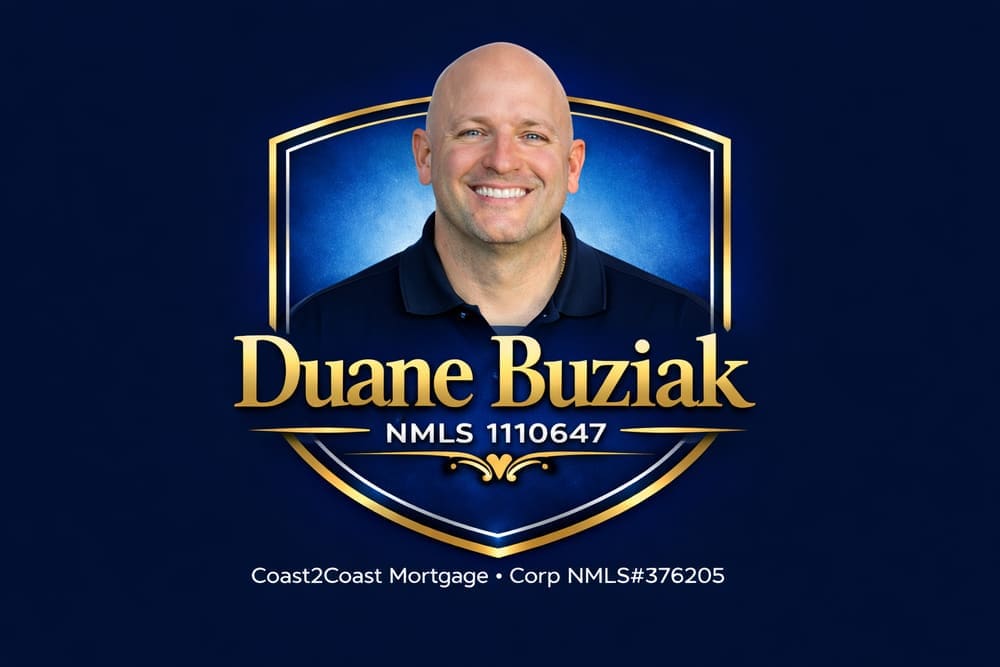
When a Florida mortgage broker earns back-to-back national recognition from the Scotsman Guide, it deserves more than a passing glance. This isn’t a self-nominated award or a paid membership badge. Scotsman Guide Top Originator status is earned through verified loan volume, confirmed directly with lenders, not self-reported by the originator.
Duane Buziak, Mortgage Maestro (NMLS #1110647), earned consecutive Scotsman Guide Top Originator recognition backed by $51.2 million in verified loan volume and three separate UWM awards. That track record means something concrete for Florida homebuyers who are trying to figure out which mortgage professional is actually equipped to help them close.
Florida’s real estate market is unlike any other in the country. Coastal flood insurance obligations, county property tax rates that vary significantly from Miami-Dade to Hillsborough to Orange County, a no-state-income-tax advantage that affects real affordability, and a competitive market in cities like Tampa, Orlando, Miami, Jacksonville, Naples, and Sarasota all create a layered decision environment that demands a broker with genuine depth.
This article breaks down what that national recognition actually measures, how an independent broker’s structure creates financial advantages over retail lenders, how to protect your credit score while shopping rates, and how to vet any mortgage professional before you commit. Whether you’re buying your first home or refinancing an existing property, these benchmarks will help you make a more informed decision.
1. What National Originator Recognition Actually Measures
The Challenge It Solves
The mortgage industry is crowded with self-promotional claims. “Top lender,” “best rates,” “award-winning service” appear on nearly every lender’s homepage. Without a third-party verification standard, Florida homebuyers have no reliable way to distinguish genuine performance from marketing copy.
The Strategy Explained
The Scotsman Guide Top Originator ranking is one of the mortgage industry’s most rigorous third-party benchmarks. Rankings are based on verified loan volume, meaning the publication contacts lenders directly to confirm the numbers. Originators cannot simply submit their own figures and claim a ranking.
Duane Buziak’s consecutive recognition, backed by $51.2 million in verified loan volume and Triple UWM Awards, is documented across two independently published press releases. You can review the verified record directly:
Yahoo Finance: Virginia Mortgage Professional Duane Buziak Earns Scotsman Guide Recognition
For Florida homebuyers, this matters because verified loan volume represents real closed transactions for real borrowers. It is a performance signal, not a promotional one. You can explore the full breakdown of what this recognition means in our detailed overview of Duane Buziak’s Scotsman Guide Top Originator recognition and what it means for Florida homebuyers.
Implementation Steps
1. Ask any mortgage professional for their NMLS number and verify it at NMLS Consumer Access before engaging further.
2. Search the Scotsman Guide’s published rankings to see if your originator appears. Rankings are publicly searchable and updated annually.
3. Ask specifically: “Is your loan volume verified by a third party, or is this self-reported?” The distinction matters.
Pro Tips
Volume alone doesn’t tell the whole story, but it does confirm that an originator has successfully navigated the full mortgage process at scale. An originator with $51.2 million in verified closed loans has handled complex transactions, tight timelines, and difficult underwriting scenarios. That experience directly benefits you when your file hits a snag.
2. The Independent Broker Advantage: Hundreds of Lenders vs. One Product Shelf
The Challenge It Solves
Many Florida homebuyers walk into a mortgage process not realizing they’re being quoted from a single lender’s internal product menu. Retail lenders, including well-known names like Rocket Mortgage, Movement Mortgage, Freedom Mortgage, PennyMac, Guild Mortgage, Fairway Independent Mortgage, CrossCountry Mortgage, Atlantic Bay Mortgage, and Embrace Home Loans, originate loans from their own product shelf. That means their loan officer’s job is to fit your file into their available programs.
The Strategy Explained
An independently licensed mortgage broker operates differently. Rather than working from a single lender’s product set, an independent broker accesses hundreds of wholesale lenders simultaneously. This structural difference creates genuine competitive pressure on rates, fees, and program availability, because lenders are competing for your loan rather than simply processing it. Understanding how mortgage brokers work in Florida can help you see exactly why this model benefits borrowers in ways a retail lender simply cannot replicate.
This distinction is factual, not a criticism of retail lenders. Both models exist for legitimate reasons. The question is which structure serves your specific situation better.
Broker vs. Retail Lender: Structural Comparison
Feature | Independent Broker | Retail / Direct Lender
Lender Access: Hundreds of wholesale lenders | Single institution’s product shelf
Rate Competition: Multiple lenders competing for your loan | Internal rate menu only
Program Flexibility: Broad: Conventional, FHA, VA, USDA, Jumbo, Non-QM, DSCR | Varies by institution; may be limited
Credit Score Range: Can access programs down to 500 score | Depends on institution minimums
Origination Fees: Negotiable across lender options | Set by institution
Florida Market Expertise: Broker-specific; varies by individual | Varies by institution and loan officer
Implementation Steps
1. When comparing mortgage options, ask every originator: “How many lenders do you have access to, and are they wholesale or retail?”
2. Request a Loan Estimate (LE) from at least two sources before committing. Federal law requires lenders to provide this document within three business days of application.
3. Compare the APR, not just the interest rate. APR includes fees and gives a more complete picture of total loan cost. If you want a structured approach to this process, our guide on how to compare multiple mortgage lenders at once walks through every step.
Pro Tips
In Florida’s active markets, particularly Tampa, Miami, and Orlando, sellers often favor buyers who can demonstrate strong pre-approval backing. A broker with verified lender relationships and a track record of closed volume can provide that credibility in a competitive offer situation.
3. NoTouch Credit: How to Shop Rates Without Damaging Your Score
The Challenge It Solves
One of the most common reasons Florida homebuyers avoid rate shopping is fear of credit score damage. The concern is understandable: applying to multiple lenders can trigger multiple hard inquiries, each of which can reduce your score. For borrowers already near a program threshold, even a small drop can change loan eligibility or pricing.
The Strategy Explained
The NoTouch Credit process uses a soft-pull pre-qualification approach, meaning your credit is reviewed without triggering a hard inquiry. This uses VantageScore 4.0, which is increasingly used for soft-pull pre-qualification assessments, allowing a broker to evaluate your credit profile and identify eligible loan programs without any impact to your score. Our detailed guide on Florida mortgage eligibility checks without hurting your credit score explains exactly how this process works and what to expect at each step.
This matters across the credit spectrum. Borrowers with scores as low as 500 can explore FHA program eligibility without risking a further score reduction. Borrowers with strong scores can shop multiple programs and lenders without accumulating inquiry marks that could affect their rate tier.
According to HUD.gov, FHA loans allow credit scores as low as 500 with a 10% down payment, and 3.5% down with a 580 or higher score. Knowing where you stand before triggering a hard pull gives you a strategic advantage.
Implementation Steps
1. Before authorizing any credit pull, ask explicitly: “Is this a soft pull or a hard pull?”
2. Use the NoTouch Credit pre-qualification to understand your program eligibility first. This gives you a realistic picture of loan options before you’re committed to any application.
3. Once you’ve identified the right program and lender, authorize the hard pull with confidence, knowing the outcome is likely to match what the soft pull indicated.
Pro Tips
FICO’s rate-shopping window allows multiple hard inquiries for the same loan type within a short period (typically 14 to 45 days depending on the scoring model) to count as a single inquiry. Even so, starting with a soft pull gives you a cleaner baseline and avoids unnecessary inquiries during the exploratory phase.
4. Florida’s Unique Cost Layers: What Your DTI Calculation Must Include
The Challenge It Solves
Florida homebuyers frequently receive pre-approval estimates that look affordable on paper, then discover the actual monthly payment is significantly higher once all Florida-specific costs are factored in. A broker who doesn’t account for flood insurance, county property taxes, and HOA fees in your debt-to-income ratio mortgage qualification calculation is giving you an incomplete picture.
The Strategy Explained
Florida has several cost layers that don’t apply in many other states. Understanding each one is essential to accurate affordability analysis.
No State Income Tax: Florida has no personal state income tax, a provision established in Article VII, Section 5 of the Florida Constitution. This means your take-home pay as a percentage of gross income is higher than in states with income tax. For DTI calculations, this can meaningfully improve your real affordability relative to borrowers in high-tax states.
Flood Insurance: Properties in Special Flood Hazard Areas (SFHAs) with federally backed mortgages are required to carry flood insurance through the National Flood Insurance Program (NFIP) or an approved private insurer. Coastal Florida markets, including Naples, Sarasota, Miami, and parts of Tampa Bay, have significant SFHA exposure. According to FEMA.gov, flood insurance is a separate policy from homeowners insurance and must be factored into monthly housing costs. In high-risk coastal zones, this can be a material monthly expense.
County Property Tax Variation: Florida property tax rates vary significantly by county based on annual millage rates set by local taxing authorities. Miami-Dade, Hillsborough, and Orange County each carry different effective rates that materially affect monthly housing costs. For accurate affordability modeling, always request a county-specific tax estimate from your broker, not a statewide average.
HOA Fees: Many Florida communities, particularly in South Florida and master-planned developments near Orlando and Tampa, carry monthly HOA fees that lenders include in DTI calculations. These can range from modest to substantial depending on the community.
Florida Market Cost Layer Comparison (Illustrative Framework)
Cost Category | Miami / South Florida | Tampa Bay Area | Orlando Area | Naples / Sarasota
State Income Tax: None | None | None | None
Flood Insurance Exposure: High (coastal SFHA) | Moderate to High | Lower (inland) | High (coastal SFHA)
Property Tax Variation: Miami-Dade millage applies | Hillsborough millage applies | Orange County millage applies | Collier / Sarasota millage applies
HOA Prevalence: Very common | Common | Common | Very common
Note: Property tax millage rates change annually. Always verify current rates with the applicable county property appraiser’s office.
Implementation Steps
1. Request a full payment breakdown from your broker that includes principal, interest, property taxes (county-specific), homeowners insurance, flood insurance (if applicable), and HOA fees. This is your true PITI+.
2. Verify flood zone status for any property you’re considering using FEMA’s Flood Map Service Center before making an offer.
3. Ask your broker to run your DTI using the complete payment figure, not just principal and interest.
Pro Tips
Florida’s no-income-tax advantage is real but often overlooked in affordability conversations. If you’re relocating from a state with a 5% or higher income tax rate, your effective purchasing power in Florida is meaningfully higher. A broker who understands this context can help you frame affordability accurately rather than conservatively.
5. Loan Program Breadth: From 500 Credit Score to Jumbo and Non-QM
The Challenge It Solves
Florida borrowers are frequently turned away by banks and credit unions because their credit profile, income documentation type, or loan size falls outside the institution’s narrow program range. Self-employed borrowers, real estate investors, borrowers rebuilding credit, and high-net-worth buyers purchasing in Naples or Miami Beach all face scenarios where standard bank products simply don’t fit.
The Strategy Explained
Access to hundreds of wholesale lenders means access to a much wider range of loan programs. The table below summarizes the primary programs available and their key parameters.
Loan Program Matrix
Program | Min. Credit Score | Down Payment | Key Use Case
Conventional: Typically 620+ | 3% to 20%+ | Primary purchase, refinance, investment
FHA: 500 (10% down) / 580 (3.5% down) | 3.5% to 10% | First-time buyers, credit rebuilding (Source: HUD.gov)
VA: No official minimum (lender overlay applies) | 0% | Eligible veterans and active-duty service members
USDA: Typically 640+ | 0% | Rural and suburban Florida properties in eligible areas. For a complete breakdown of eligibility requirements, see our guide to the Florida USDA home loan program.
Jumbo: Typically 680+ | 10% to 20%+ | Loan amounts above $806,500 (2025 FHFA conforming limit). Florida buyers in high-value markets should review the full jumbo loan requirements in Florida before assuming they won’t qualify.
Non-QM: Varies by program | Varies | Borrowers outside standard qualification guidelines
Bank Statement: Typically 620+ | 10%+ | Self-employed borrowers using bank deposits as income
DSCR: Typically 620+ | 20%+ | Real estate investors; qualification based on rental income
Note: The 2025 baseline conforming loan limit is $806,500 for single-family homes per the FHFA. Florida statewide limit is generally the baseline except in a small number of high-cost counties. Loan parameters vary by lender and program. All figures are representative and subject to change.
For Florida homeowners who already own property, certain programs allow cash-out refinances up to 90% loan-to-value. This is a program-specific feature and not available universally, but it represents a meaningful equity-access tool for homeowners who want to leverage appreciation without selling.
Implementation Steps
1. Before assuming you don’t qualify, use a soft-pull pre-qualification to see which programs your credit profile actually supports.
2. If you’re self-employed, ask specifically about bank statement loan programs before accepting a denial based on W-2 income requirements.
3. If you’re a real estate investor in Florida, ask about DSCR loan eligibility, which qualifies based on the property’s rental income potential rather than your personal income documentation.
Pro Tips
Many Florida borrowers don’t realize that a denial from one institution doesn’t mean denial across the board. The program that fits your file may exist at a wholesale lender that a retail bank simply doesn’t have access to. This is precisely where a broker with hundreds of lender relationships adds tangible value.
6. Speed to Close and 24/7 Access: Why Timeline Matters in Florida’s Market
The Challenge It Solves
In active Florida markets, a slow close can cost you the home. Sellers in competitive areas like Tampa, Orlando, Miami, and Jacksonville regularly receive multiple offers. A buyer who can demonstrate a credible, fast-closing pre-approval has a meaningful competitive advantage over one who is still waiting on documentation from a lender’s call center.
The Strategy Explained
Close timelines are directly connected to lender relationships and process efficiency. A broker with verified loan volume at scale, including the UWM award recognition that Duane Buziak holds, has established processing relationships that support faster turnaround. These aren’t hypothetical efficiencies; they are the byproduct of consistently closing loans at volume. Understanding how long mortgage approval takes in Florida gives buyers a realistic timeline to plan around and helps set expectations with sellers and realtors.
24/7 application access matters because Florida homebuyers don’t shop on a 9-to-5 schedule. Weekend open houses, evening negotiations, and last-minute rate lock decisions require an originator who is accessible when you need them, not just during business hours. The advantages of 24/7 mortgage application access go beyond convenience — they can be the difference between securing a property and losing it to a faster buyer.
From a realtor’s perspective, broker reliability is a significant factor in referral decisions. A realtor who has seen a broker close consistently, on time, and with clear communication is far more likely to recommend that broker to their clients. Verified loan volume is part of what builds that trust over time.
Implementation Steps
1. Ask your broker for their average close timeline on purchase transactions and request references from recent clients or referring realtors if you want independent confirmation.
2. Confirm that your pre-approval letter is lender-backed, not just broker-issued. A pre-approval supported by a wholesale lender’s underwriting carries more weight with sellers.
3. Ask about digital application and document upload capabilities. 24/7 access to your file means you can submit documents and respond to conditions outside of business hours, which accelerates processing.
Pro Tips
Realtors in Florida’s competitive markets pay close attention to which mortgage professionals close reliably. If you’re working with a realtor, ask them which brokers they’ve seen perform well under pressure. A broker with a verified track record of closed volume is likely already on that list.
7. How to Vet Any Mortgage Professional: A Florida Homebuyer’s Checklist
The Challenge It Solves
Florida homebuyers have no shortage of mortgage options, but evaluating them objectively is genuinely difficult. Marketing language is designed to be persuasive, not informative. Without a structured vetting framework, borrowers often default to whoever contacted them first or whoever quoted the lowest rate in an initial conversation, neither of which is a reliable selection criterion.
The Strategy Explained
A structured vetting process uses verifiable, third-party data points rather than marketing claims. The checklist below applies to any mortgage professional you’re considering, including Duane Buziak. Transparency in this process is the point. For a broader look at how to evaluate your options, our guide to Florida homebuyer loan options covers the full landscape of programs and what to look for in each scenario.
Implementation Steps
1. Verify NMLS Registration: Every licensed mortgage originator in Florida must be registered. Search the originator’s NMLS number at NMLS Consumer Access. Duane Buziak’s NMLS number is #1110647. Verify it directly.
2. Check for Third-Party Recognition: Ask whether the originator appears in the Scotsman Guide Top Originator rankings. This is publicly searchable and based on verified loan volume, not self-nomination.
3. Confirm Soft-Pull Pre-Qualification: Ask explicitly whether initial credit review is a soft pull or hard pull. Any originator unwilling to offer a soft-pull option before a formal application is asking you to accept credit risk before you’ve committed to anything.
4. Request and Review the Loan Estimate: Federal law requires a Loan Estimate (LE) within three business days of application. Review Section A (origination charges), Section B (services you cannot shop for), and the APR. Compare these across at least two originators.
5. Verify Florida State Licensure: Confirm the originator holds an active Florida mortgage license through the NMLS portal. Out-of-state originators must hold a Florida license to originate loans in the state.
Pro Tips
The Loan Estimate is one of the most powerful consumer protection tools in the mortgage process. It is standardized across all lenders, which makes direct comparison straightforward. If an originator discourages you from comparing LEs or creates urgency around skipping that step, treat it as a red flag.
Frequently Asked Questions: Florida Mortgage Borrower Q&A
Q: What is the Scotsman Guide Top Originator ranking, and why does it matter?
A: The Scotsman Guide Top Originator ranking is an annual industry recognition based on verified loan volume, confirmed directly with lenders rather than self-reported by the originator. It represents one of the few third-party performance benchmarks available to homebuyers evaluating mortgage professionals. Consecutive recognition backed by $51.2 million in verified loan volume indicates sustained, high-volume performance across real borrower transactions.
Q: How does a mortgage broker differ from a direct lender like Rocket Mortgage or Freedom Mortgage?
A: A direct lender originates loans from its own product shelf, meaning your loan officer’s options are limited to that institution’s available programs. An independent mortgage broker accesses hundreds of wholesale lenders, creating competitive pressure on rates and fees and broader program availability. This is a structural difference, not a quality judgment about any specific institution.
Q: Will checking my eligibility affect my credit score?
A: The NoTouch Credit soft-pull pre-qualification process uses VantageScore 4.0 and does not trigger a hard inquiry. Your credit score is not affected by the initial eligibility check. A hard pull is only initiated when you formally authorize a mortgage application with a specific lender.
Q: I’m self-employed in Florida. Can I still qualify for a mortgage?
A: Yes. Bank statement loan programs allow self-employed borrowers to qualify using bank deposit history rather than W-2 income or tax returns. These are non-QM programs available through wholesale lenders that many retail banks do not offer. A broker with access to hundreds of lenders is far more likely to find a program that fits your income documentation type.
Q: How do I verify that a mortgage professional is licensed in Florida?
A: Use the NMLS Consumer Access portal at nmlsconsumeraccess.org. Search by name or NMLS number. Every originator legally permitted to originate mortgages in Florida must hold an active Florida license. You can verify Duane Buziak at NMLS #1110647 directly through that portal.
Recognition as a Starting Point, Not the Finish Line
National recognition from the Scotsman Guide is a verifiable signal of performance. It tells you that an originator has closed real loans at verified volume, that their track record has been confirmed by a third-party publication, and that they have the lender relationships necessary to support that kind of sustained output. That matters.
But the real test is whether a broker’s process, access, and tools serve your specific Florida homebuying situation. Does their lender access cover the program you need? Do they understand flood insurance obligations in coastal markets? Can they account for county-specific property tax variation in your DTI? Will they protect your credit score during the shopping process? Are they available when a Saturday evening negotiation requires a fast answer?
The strategies in this article give you a framework to evaluate any mortgage professional against those standards, including Duane Buziak. Hundreds of lenders. NoTouch Credit soft-pull pre-qualification. Loan programs from a 500 credit score to jumbo and non-QM. Florida-specific cost expertise. 24/7 access. Fastest close times. Cash-out refinance options up to 90% LTV for eligible programs.
If you’re ready to explore your options without any impact to your credit score, check your eligibility now and see what programs are available for your specific situation.
Legal Disclaimer: This article is for educational purposes only and does not constitute financial, legal, or mortgage advice. Loan programs, rates, credit score requirements, and eligibility criteria are subject to change without notice and vary by lender. Rate and payment examples are illustrative only and are not guaranteed. Flood insurance requirements are determined by property location and lender guidelines. Property tax rates vary by county and change annually. All loan applications are subject to underwriting approval. Not all borrowers will qualify for all programs. Cash-out refinance up to 90% LTV is available on certain programs only and is not a universal feature. This content is intended for informational purposes and applies to the State of Florida only.
Duane Buziak, Mortgage Maestro | NMLS: #1110647 | Licensed in VA · FL · TN · GA | VA Broker of the Year 2024-2025 | Top 1% Nationwide | Coast2Coast Mortgage | DuaneBuziakMortgageMaestro.com | (804) 212-8663